
August is Known for Black Swans
August is the month when many families take their final summer vacation. It’s also when back-to-school preparations start and football season comes into focus. But August has a more unsettling side for investors. It’s historically been a month of surprises. Not always the kind we prefer. Over the past 35 years, investors have navigated seven “black swan” events in August. Some were worse than others, but all led to disappointing days for investors.
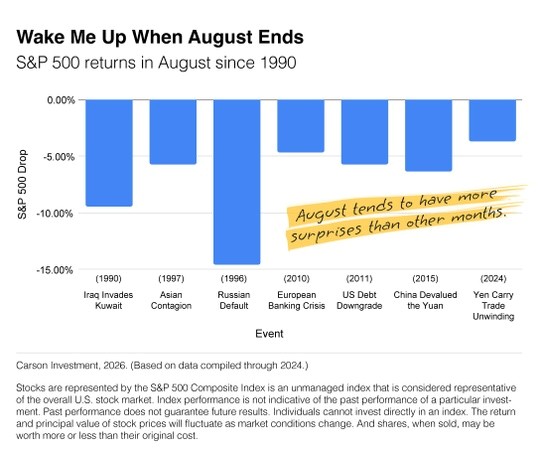
As summer comes to a close, it’s traditionally a time that investors expect a pickup in market volatility. September and October have built their reputations over time, and this year, the November elections could add another wave of uncertainty.
The old phrase, “hope for the best, prepare for the worst,” is worth keeping in mind during this time of year. Your portfolio is prepared for either outcome because it reflects your goals, time horizon, and risk tolerance. If the best happens, you’re ready. If another August surprise rolls around, you’re prepared.
Market Insight
Stocks ended last week down as Q2 corporate results, Middle East developments and the chips trade took investors for a choppy ride.
The Nasdaq Composite Index was under the most pressure, falling 2.13 percent. The Standard & Poor’s 500 Index lost 0.61 percent, while the Dow Jones Industrial Average slipped 0.38 percent. The MSCI EAFE Index, which tracks developed overseas stock markets, rose 0.35 percent.
A Volatile Week
After a sluggish start on Monday, stocks rebounded on Tuesday as the chips trade led the markets higher, as investors turned their attention to Q2 corporate earnings results. Then stocks stalled midweek as oil prices and bond yields rose and investors digested some initial Q2 reports. The S&P 500 ended just below the flatline, while the Dow went sideways and the Nasdaq posted a modest loss. Stocks opened lower Thursday as mixed corporate updates from two of the world’s largest companies soured investor sentiment. One company said it was raising its AI spending forecast for the year, which unsettled investors who believed other companies may have to do the same. Sentiment turned positive Friday morning as investors cheered quarterly results and guidance for one big tech company. But markets retreated in the afternoon as investors fretted over oil prices.
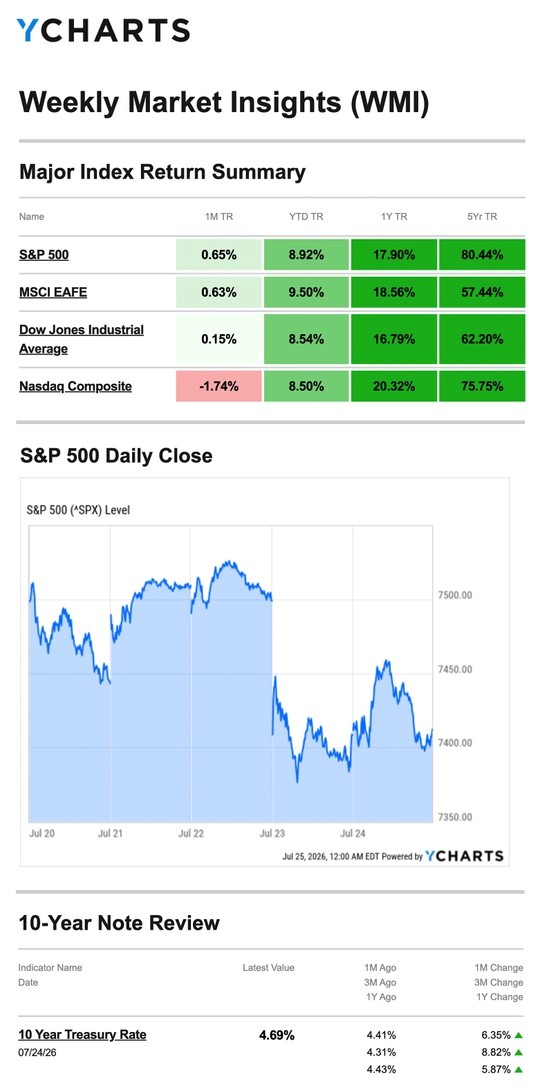
Last week was one of the busiest for the Q2 2026 corporate reporting season. Corporate earnings are a key driver of stock prices, so updated corporate guidance can increase market volatility. Last week, two influential companies said they intended to spend more money this year than expected, which caught investors off guard. As more Q2 corporate reports get released, expect investors to pay close attention to any spending updates for other companies.
Everyone’s Talking About IPOs
When investors hear the words “initial public offering,” it’s easy to imagine they are buying a piece of a dream. Consider the most celebrated IPO in recent history, which started trading in early June. Some assumed that when this aerospace company went public, they would feel like they were participating in a mission to Mars. But IPOs don’t work that way.
When a company goes public, the proceeds rarely go toward the bold mission that made the company famous. More often, the money satisfies early investors, pays down debt or funds day-to-day operations. The romantic story and the financial mechanics can be two very different things.
Getting part of the action before trading begins is almost exclusively reserved for large institutional investors. Buying once the stock starts trading is open to anyone. But the stock price can swing dramatically, especially in the first few days of trading as the market finds its footing. So IPOs can be more complex than the headlines suggest, which is important to understand because two high-profile AI companies are expected to go public in the months ahead.
One of the AI companies reached 100 million users faster than any application in history, and the other is backed by two of the largest technology companies in the world. Both are expected to have their IPO sometime in the autumn, so prepare to see some loud headlines. So far in 2026, IPOs have raised the most money since 2021. Be ready for a record year if the two AI companies go public as expected.
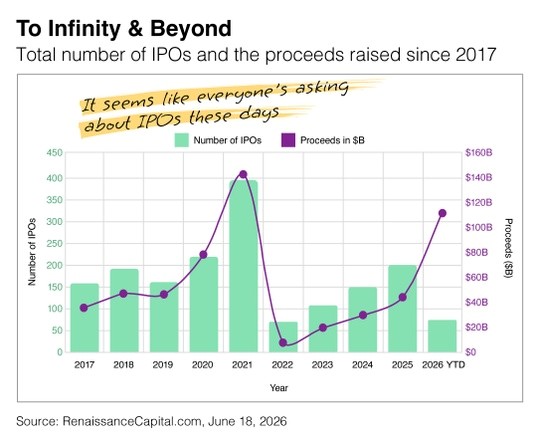
More than likely, if you have a diversified portfolio, one or more of your investments may end up owning shares in these companies. In fact, certain investments are required to purchase newly listed companies because their investment objective is to mirror the stock market or a particular index. So you may end up being an owner.
Please reach out to Adams Brown Wealth Consultants if you have any questions about the IPO market or financial planning.
Sources
WSJ.com, July 24, 2026
Investing.com, July 24, 2026
CNBC.com, July 21, 2026
SEC.gov, 2026